
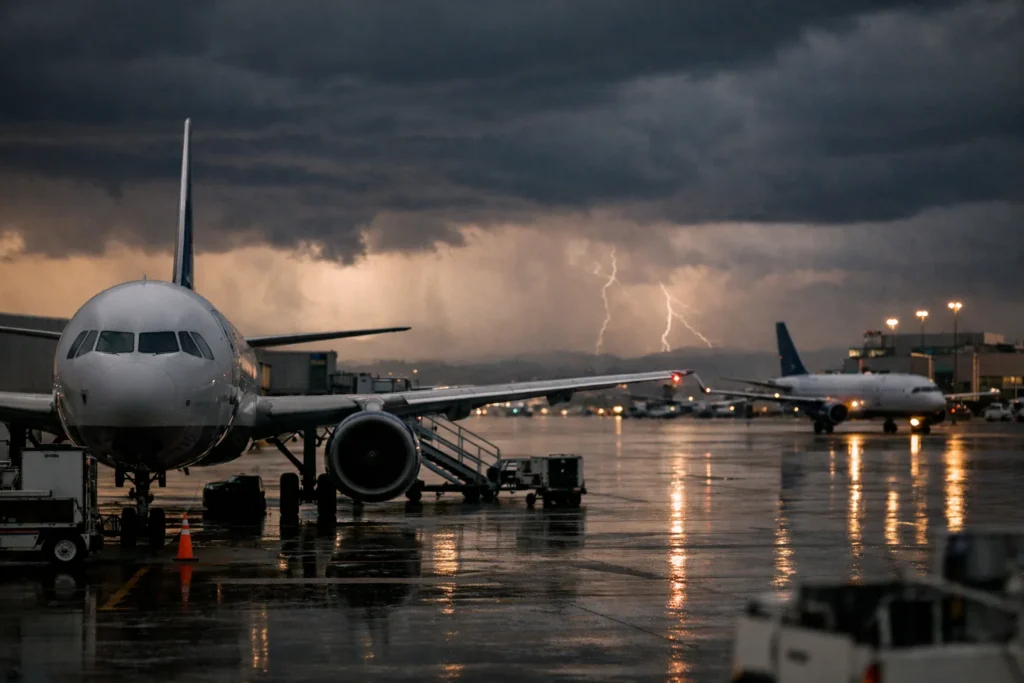
Denver flight delays escalated on Friday, August 21, when the FAA halted departures at Denver International Airport as severe thunderstorms brought dangerous winds and heavy rain. Inbound aircraft entered holding patterns or diverted to other airports during the hours-long disruption.
The ground stop lasted more than four hours
The Federal Aviation Administration issued the first ground-stop order at 4:15 p.m. MDT and extended it until 8:30 p.m. when conditions failed to improve. The initial order had been expected to last about 90 minutes.
Denver had reached 100°F (about 38°C) during the day, with high humidity contributing to thunderstorms by late afternoon. Wind gusts approached 50 knots, roughly 58 mph (93 km/h), leaving several aircraft unable to land safely.
Departing passengers remained on the ground while approaching flights circled or changed course. The interruption caused cancellations, missed connections and uncertainty across multiple airlines, with United Airlines recording the largest number of delays.
The weather shutdown followed a separate ground stop earlier in August linked to air traffic control staffing. Elsewhere in Colorado, flights at Aspen had also recently stopped because of wildfires.
Denver flight delays reached airports across four states
Aircraft approaching the Colorado hub diverted to alternative airports in Colorado, Kansas, Oklahoma and Wyoming.
- Colorado Springs, Colorado
- Wichita, Kansas
- Oklahoma City, Oklahoma
- Casper, Wyoming
Diversions can create lengthy secondary delays because aircraft may need to refuel and wait for clearance before continuing. Passengers can also miss onward flights even after their diverted aircraft eventually reaches its original destination.
Travellers and airline employees shared updates online as the situation developed. An employee identified as working for Southwest Airlines said the carrier handled 33 diversions during the shutdown, although the airline did not issue a confirmed total.
Microbursts made approaches particularly dangerous
Microbursts can cause sudden changes in wind speed and direction close to the ground, making takeoffs and landings hazardous.
The phenomenon begins when rain, hail and cold air suspended within a thunderstorm descend rapidly. The falling air strikes the ground and spreads outward, producing a short but intense burst of wind and precipitation over a limited area.
A microburst usually lasts between five and 15 minutes, but its location and strength can change quickly. Aircraft flying through one may encounter wind shear, an abrupt shift in wind that can sharply affect lift during the most critical stages of flight.
The aviation industry treats the threat conservatively because of past accidents. Investigators linked the 1985 crash of Delta Flight 191 on approach in Dallas to wind shear associated with an intense thunderstorm downdraft. Airports and aircraft now have better tools for detecting such conditions, but avoiding the affected area remains the safest response.
Similar storm conditions may return on Sunday
The heat and humidity that supported Friday’s storms are expected to return on Sunday, August 23, although forecasters cannot determine days ahead whether a thunderstorm will produce microbursts.
The FAA was not reporting adverse weather in Denver on Saturday, but another storm could cause fresh restrictions with little notice. Disruption may also continue after conditions improve because diverted aircraft and crews are away from their planned positions.
Travellers flying through Denver on Sunday should check the status of both their arriving and connecting flights before leaving for the airport. Those with tight connections should monitor airline updates closely and keep alternative arrangements in mind if another ground stop develops.