
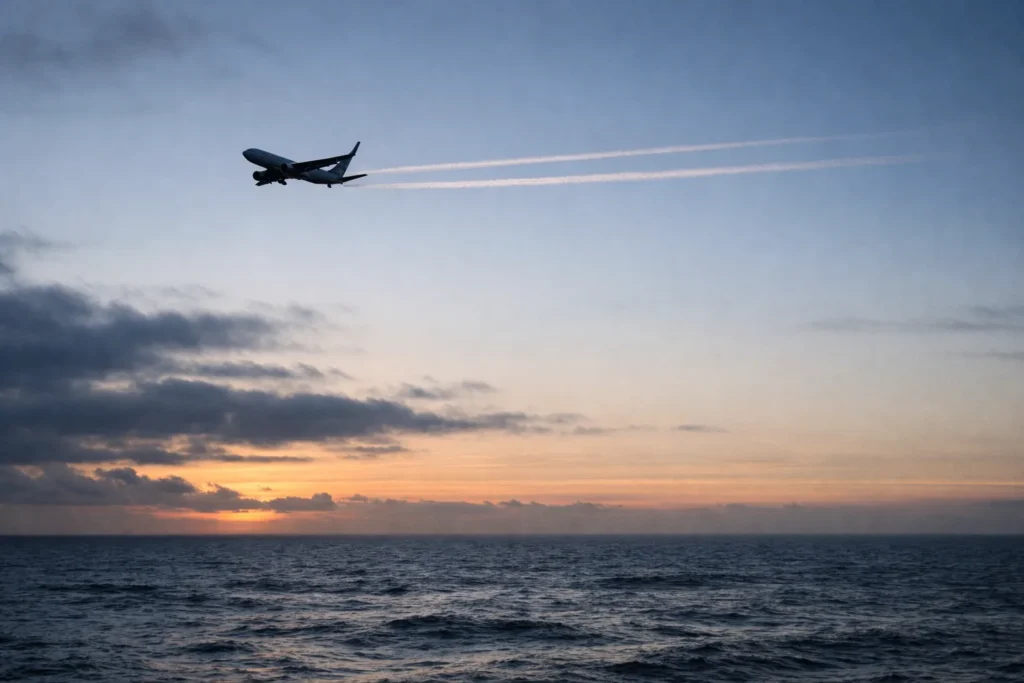
NATS will run a contrail reduction trial in Shanwick airspace during the winters of 2026–27 and 2027–28, testing whether small altitude changes can limit persistent aircraft trails. The 30-month programme will also measure the climate effect while seeking to preserve normal flight operations.
Shanwick covers the eastern half of the North Atlantic corridor and is managed by NATS, the United Kingdom’s principal air traffic control services provider. Operation Blue Skies takes the work beyond tests involving individual airlines and applies it across an entire area of oceanic airspace.
How the contrail reduction trial will work
Controllers will instruct selected aircraft to change altitude by up to about 2,000 feet (around 610 metres), allowing them to avoid atmospheric layers where persistent trails are likely to form.
The programme includes two testing campaigns, one in each winter season. Each campaign will run for between 20 and 40 days, with test periods chosen primarily during quieter traffic conditions.
Lower traffic levels should reduce the operational complexity and make it easier to coordinate aircraft receiving altitude instructions with other flights using the same airspace. The changes are vertical rather than diversions to different destinations.
Only a small share of flights will change level
Between 1% and 5% of roughly 10,000 flights crossing Shanwick during the test windows could receive an instruction to fly at a different level.
Project organisers consider that share large enough to produce statistically meaningful findings across the airspace. At the same time, most flights will continue at their planned levels, supporting the aim of testing the method without substantially changing routine operations.
The scale is central to the experiment. Earlier work focused on particular airlines, while Operation Blue Skies will examine whether targeted adjustments remain practical when coordinated across a busy transatlantic region.
Why the programme targets persistent aircraft trails
Persistent trails are the focus because condensation trails do not all behave in the same way or have the same climate effect.
The Met Office explains that they form when aircraft engine emissions encounter very cold, humid air, producing ice crystals. Moving an aircraft above or below a suitable atmospheric layer may therefore prevent a lasting trail from developing.
The project is designed to measure that approach at airspace level rather than eliminate every visible trail. Its findings will show whether limited altitude changes can deliver a measurable result while fitting around commercial flight operations.
What passengers need to know
Travellers do not need to change their booking plans because the test concerns air traffic control instructions at cruising altitude, not new routes or passenger procedures.
The periods to watch are winter 2026–27 and winter 2027–28. The announced plan does not identify exact operating days or participating airlines, although testing days will generally be selected when traffic is lighter.
Passengers on an affected flight would not choose the alternative altitude themselves; air traffic controllers would issue the instruction to the aircraft. For now, travellers can book North Atlantic journeys normally and follow any operational information supplied by their airline.