
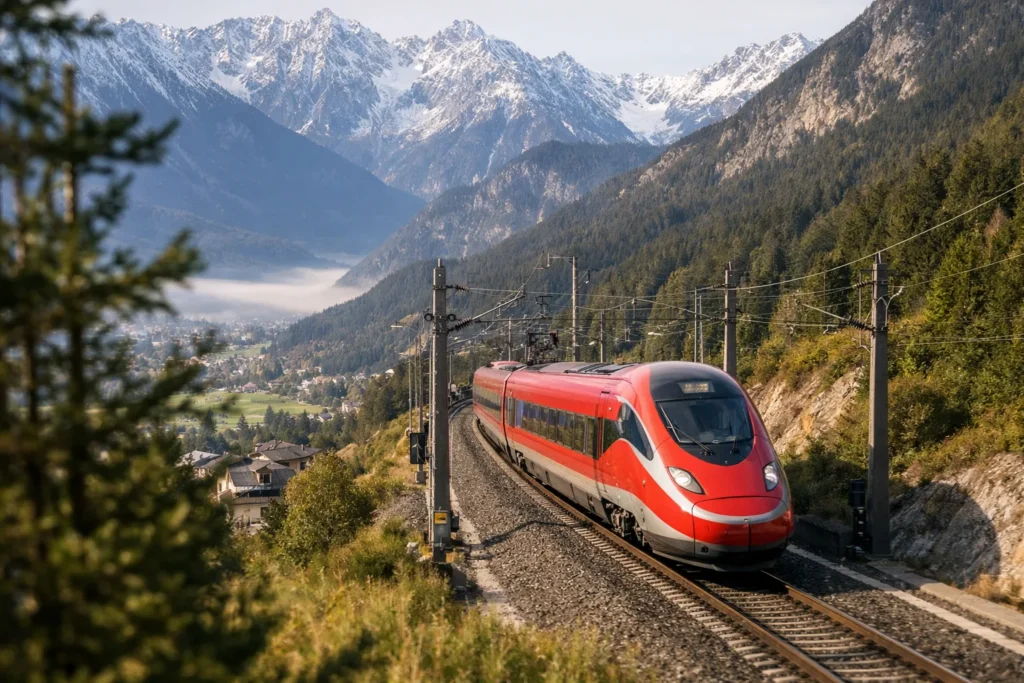
Frecciarossa to Munich services from Rome and Milan have entered testing in Germany and Austria ahead of a planned summer 2027 launch. Ferrovie dello Stato says the Trenitalia-operated trains must complete international approval before passenger operations can begin.
Which Frecciarossa to Munich route will be quicker?
The planned journey from Milan will be about two hours shorter than the trip from Rome.
FS currently envisages four connections serving the two corridors:
| Route | Approximate journey time | Main intermediate stops |
|---|---|---|
| Milan–Munich | 6 hours 30 minutes | Brescia, Verona, Rovereto, Trento, Bolzano and Innsbruck |
| Rome–Munich | 8 hours 30 minutes | Florence, Bologna, Verona, Rovereto, Trento, Bolzano and Innsbruck |
Both services would cross the Alps through Innsbruck and the Brenner corridor. The plan would give travellers from several northern Italian cities a through train towards Bavaria, while the Rome service would also collect passengers in Florence and Bologna.
How must the trains adapt for cross-border operation?
The trains must work with the different power supplies and signalling systems used across the Italian, Austrian and German rail networks.
FS is developing the project with Germany’s Deutsche Bahn and Austria’s ÖBB. An agreement between Trenitalia and Deutsche Bahn allows the operators to share technical expertise, accelerate the approval work and control its costs.
Training for German and Austrian drivers began while prototype trains were being built. Trial operations in both countries now form part of the international certification programme.
The Frecciarossa platform meets European technical standards intended to help trains operate across national networks. It was designed for use in Italy as well as France, Germany, Spain, Austria, Switzerland, the Netherlands and Belgium. Approval in each market still requires the relevant testing process.
What will the Brenner Base Tunnel change?
The Brenner Base Tunnel is expected to reduce these journeys by around one hour after it opens.
FS plans to expand the full Italy–Germany operation to ten connections from December 2028. The network would initially link Milan, Rome and Munich before later extensions to Naples and Berlin.
The operator also expects the new services to support rail journeys beyond the cities directly served. Frankfurt and Krakow are among the onward destinations identified as potential sources of passenger demand.
How the services fit FS’s European expansion
The German and Austrian project extends FS’s international strategy beyond its existing moves into France and Spain.
FS chief executive Gianpiero Strisciuglio has described the partnership with Deutsche Bahn and ÖBB as part of a proposed high-speed “European Metro”. The concept aims to make cross-border rail easier between European regions and major cities.
The group also has a stated goal of reaching the United Kingdom through the Channel Tunnel by 2029. That plan is separate from the Munich services and would require its own approvals and operating arrangements.
What should travellers do next?
Travellers should wait for the approval process, final timetables and ticket sales before treating the proposed journeys as confirmed.
The immediate practical change is therefore limited to planning. Passengers considering travel between Italy, Austria and southern Germany can watch for confirmation of the launch and compare the eventual schedules with existing rail and air options.
If the approvals are completed, the trains would create through journeys linking central and northern Italy with Innsbruck and Munich. Fares and booking dates have not yet been detailed.