
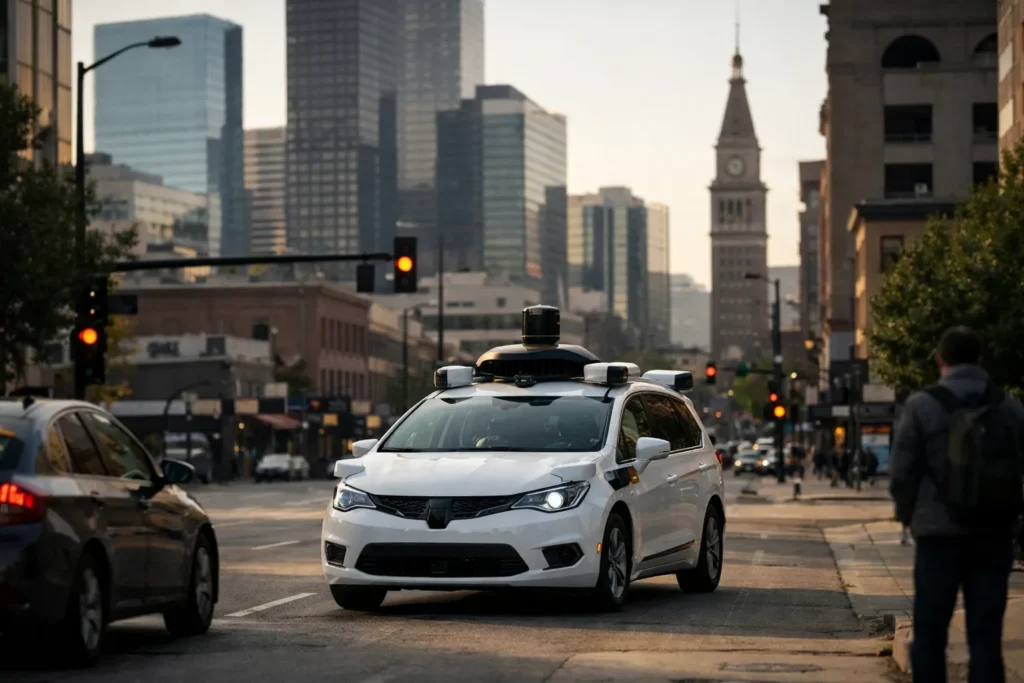
Waymo Denver service is set to open to the public very soon within an initial urban zone in Colorado’s capital. Denver International Airport and the mountains are excluded, so air passengers will still need other transport.
Waymo Denver service opens within a 50-square-mile zone
The first operating area will cover approximately 50 square miles (about 130 sq km), including most of Denver and part of Glendale.
Waymo has tested its driverless cars in Denver since mid-2025. Colorado already allows autonomous vehicles, but product communications manager Chris Bonelli says the company has not set an exact date for public rides.
The company describes its approach as a land-and-expand strategy. It starts with downtown and nearby neighborhoods, reviews operations and then enlarges the service area over time. In Phoenix, for example, the operating zone has grown to 350 square miles (about 906 sq km).
Riders within the opening zone will be able to hail fully driverless vehicles. The initial boundaries mean that people travelling beyond the covered neighborhoods will need to combine the service with another form of transport.
Only three current markets include airport access
Of the 11 cities where Waymo currently operates, only three provide rides connected to an airport.
| Airport | Current access | Rollout history |
|---|---|---|
| Phoenix Sky Harbor International Airport | Curbside service at terminals 3 and 4 | Waymo first reached the 44th Street Sky Train station after two years, with terminal access following two years later. |
| San Jose Mineta International Airport | Curbside pickups and drop-offs | Airport service began in late 2025, after commercial rides launched in the Bay Area in 2024. |
| San Francisco International Airport | Pickups and drop-offs on the first level of the Rental Car Center | Access began in January 2026. |
Adding Denver International Airport requires a separate process. Waymo must complete viability assessments and secure a commercial operator permit from airport authorities. The company also plans internal audits after city operations begin.
Those requirements leave Denver without a confirmed timetable for driverless airport rides. Previous launches show that the gap between city service and airport access can vary substantially by market.
Denver forms part of a broader expansion plan
Waymo plans to enter as many as 20 additional cities, with Las Vegas, San Diego and Tampa among the destinations identified for future service.
The company began in 2009 as an autonomous-driving project overseen by Google X. In 2015, a blind passenger completed a fully autonomous journey in a prototype vehicle in Austin, Texas.
Google separated the project into Waymo in 2016 under shared parent company Alphabet. Testing started in Phoenix the following year, while the company’s driverless taxi service opened commercially in 2020.
The Denver launch extends that network into a city where winter weather and the surrounding mountain region create different operating conditions from established markets in Arizona and California. The mountains, however, are not part of the opening service area.
What Denver travellers should arrange
Airport passengers should continue planning journeys by public transport, conventional rideshare services or airport shuttles until Waymo receives approval to serve the airport.
Travellers should watch for the confirmed public opening date and the final operating map before relying on a driverless ride within the city. Those heading to or from Denver International Airport should book an alternative transfer rather than assume the new service will reach the terminals.
Future expansion could bring the airport into the network, but no date has been announced. For now, the launch primarily changes short urban journeys within the initial Denver and Glendale coverage area.