
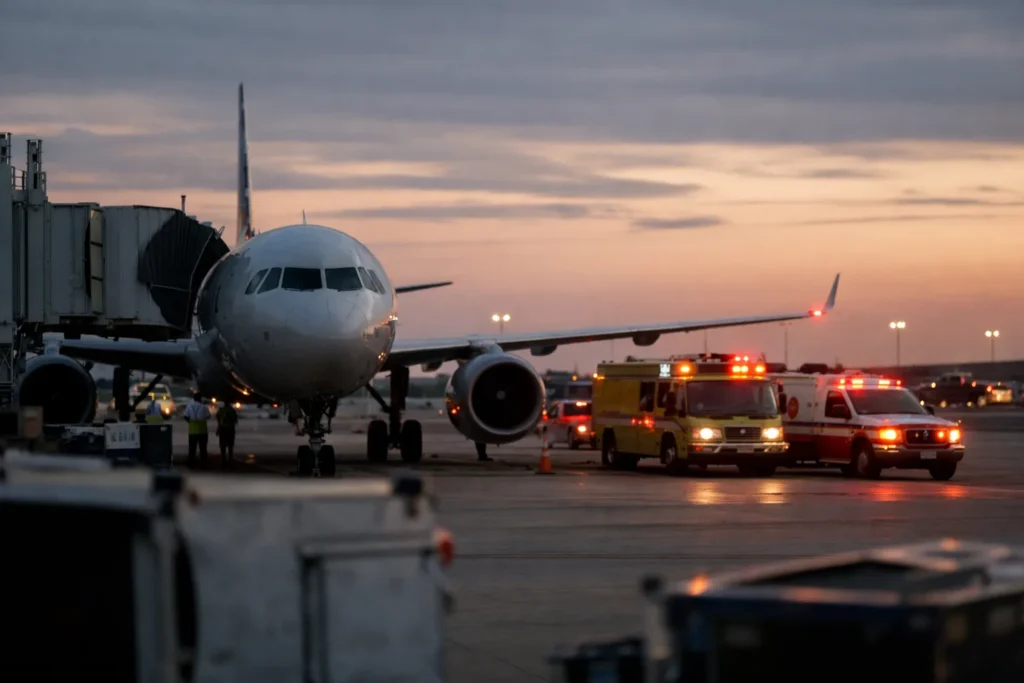
An American Airlines laptop fire prompted Flight 2398 to declare an emergency while landing at Dallas/Fort Worth International Airport on Friday evening. The Airbus A321, carrying 133 people from Atlanta, landed safely amid reports of possible burn injuries.
Crew contained the device before touchdown
Flight attendants brought the smoking device under control before the aircraft touched down.
Air traffic control audio captured the crew reporting a cabin fire near the back of the aircraft after a passenger’s computer caught fire. The pilot later told controllers that the device had been contained.
Emergency personnel met the aircraft after landing. It then taxied under its own power to a gate at Terminal C. American Airlines thanked the crew for responding quickly and confirmed that smoke had come from a customer’s device.
Commercial aircraft carry heat-resistant containment bags for overheated lithium batteries. These allow cabin crews to isolate a device and limit the spread of heat, smoke and flames.
American Airlines laptop fire may have burned up to five people
The pilot estimated that about four or five passengers near the device may have suffered burns.
That initial assessment did not amount to confirmation that five people were injured. Later reports said medical teams treated one passenger after the aircraft reached the ground. No further information about that person’s condition was given.
The crew declared the emergency during the arrival at Dallas/Fort Worth, rather than earlier in the journey from Hartsfield-Jackson Atlanta International Airport.
Thermal runaway can make batteries ignite suddenly
A lithium battery can catch fire when an uncontrolled rise in temperature, known as thermal runaway, causes it to overheat and ignite.
Damage, incorrect packing or exposure to water can trigger such an event. The failure may develop with little warning, leaving crews only a short time to reach and contain the affected device.
The Federal Aviation Administration recorded 93 thermal runaway incidents in 2025, slightly more than in the previous year. Most happened aboard passenger aircraft. Portable battery packs were the leading cause, followed by e-cigarettes and mobile phones.
Laptops accounted for eight of the 93 incidents, making them a less common cause than several smaller rechargeable devices.
Seat mechanisms create another laptop risk
A computer can also become hazardous if it slips into a reclining or lie-flat seat. Moving the seat may crush or pierce the battery without the passenger realising it.
In a separate November incident, a United Airlines flight from London Heathrow to Washington Dulles diverted to Dublin after a laptop slipped between the cabin wall and a seat and fell into an inaccessible area. In July 2024, three passengers were injured when a computer inside a bag caught fire before an American Airlines departure from San Francisco.
Battery rules determine what travellers should do
Spare lithium batteries and power banks must travel in hand luggage, not checked baggage.
Keeping them in the cabin means crew members can reach an overheating device quickly. A fire inside the cargo hold is harder to detect and access during a flight.
American Airlines, Delta Air Lines, Southwest Airlines and United Airlines have introduced restrictions on portable chargers since 2025, although those measures do not cover laptops. Travellers should check their airline’s current charger policy before departure because the exact restrictions may vary.
- Place spare batteries and power banks in cabin baggage.
- Tell the crew immediately if a device becomes unusually hot, produces smoke or begins to swell.
- Ask a crew member for help if a laptop slips into a seat rather than moving the seat mechanism.
The Dallas incident does not create a reason to change flight bookings. Its practical lesson is to keep rechargeable devices protected, accessible and within the airline’s cabin-baggage rules.