
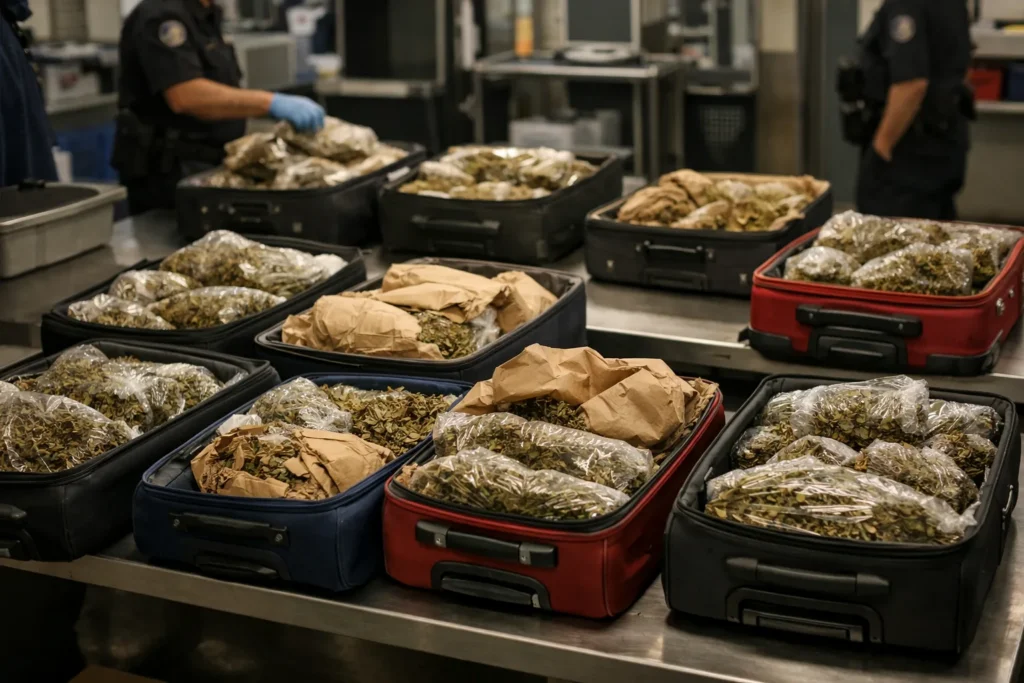
The Dulles khat seizure led to the arrest of New York passenger Mohamed Diawara on August 15 after officers found 368 pounds (about 167 kilograms) of the controlled substance in his luggage. U.S. Customs and Border Protection estimated its street value at around $44,000.
Officers identified the drug during a secondary inspection
CBP referred Diawara, 25, to a secondary baggage check after he arrived at Washington Dulles International Airport on a flight from Paris.
Officers discovered dried organic material spread across eight checked suitcases. Field tests identified it as khat, and CBP described the shipment as a commercial quantity.
CBP confiscated the material and transferred Diawara to Metropolitan Washington Airports Authority Police. He faces felony charges of possession with intent to distribute and transporting a controlled substance into the Commonwealth of Virginia.
Christine Waugh, CBP area port director for Washington, D.C., described the shipment as a brazen smuggling attempt. She credited customs officers with stopping it and said CBP continues to work with other law-enforcement agencies to pursue suspected smugglers.
Khat contains two federally controlled stimulants
Khat is illegal under U.S. federal drug rules because it contains cathinone, a Schedule I controlled substance, and cathine, which is listed under Schedule IV.
The plant, also called Abyssinian tea or African salad, is grown mainly in East Africa and the Arabian Peninsula. Chewing it produces an amphetamine-like stimulant effect, while dried leaves can be boiled to make a stimulant drink.
The Drug Enforcement Administration lists possible toxicity symptoms including delusions, reduced appetite, breathing difficulty, high blood pressure and an increased heart rate. The World Health Organization classified khat as a drug of abuse in 1980.
Dulles khat seizure follows a sharp rise in interceptions
CBP data show that officers and agents are confiscating far more khat than they did two fiscal years ago.
| Reporting period | Khat confiscated |
|---|---|
| Previous fiscal year | About 1,600 pounds |
| Last fiscal year | About 46,000 pounds |
| Current fiscal year through July | Almost 19,000 pounds |
Recent enforcement cases have involved other drugs and undeclared cash as well. In May, officers at the Laredo Port of Entry in Texas intercepted narcotics valued at $455,000 from an American traveler.
In April, CBP officers at Philadelphia International Airport confiscated more than $44,000 in unreported currency from a U.S.-Peruvian traveler heading to Cancun.
Travelers should check every item before entering the US
Passengers should confirm that unfamiliar plants, stimulants and medicines are legal before packing them for a journey to the United States.
A referral to secondary inspection does not automatically mean a traveler has broken the law. It allows officers to examine baggage, verify information and investigate anything that appears inconsistent or suspicious. If they find suspected contraband, they can confiscate it and refer the passenger to police.
- Know what is inside every checked and carry-on bag, including packages received from someone else.
- Check U.S. rules before traveling with plant products, medicines or controlled substances.
- Declare goods and currency when customs rules require it.
- Keep travel documents available and answer inspection questions accurately.
Before the next U.S. trip, passengers should inspect their baggage and resolve any uncertainty about an item before departure. A routine arrival can become a criminal investigation when officers identify a prohibited substance.