
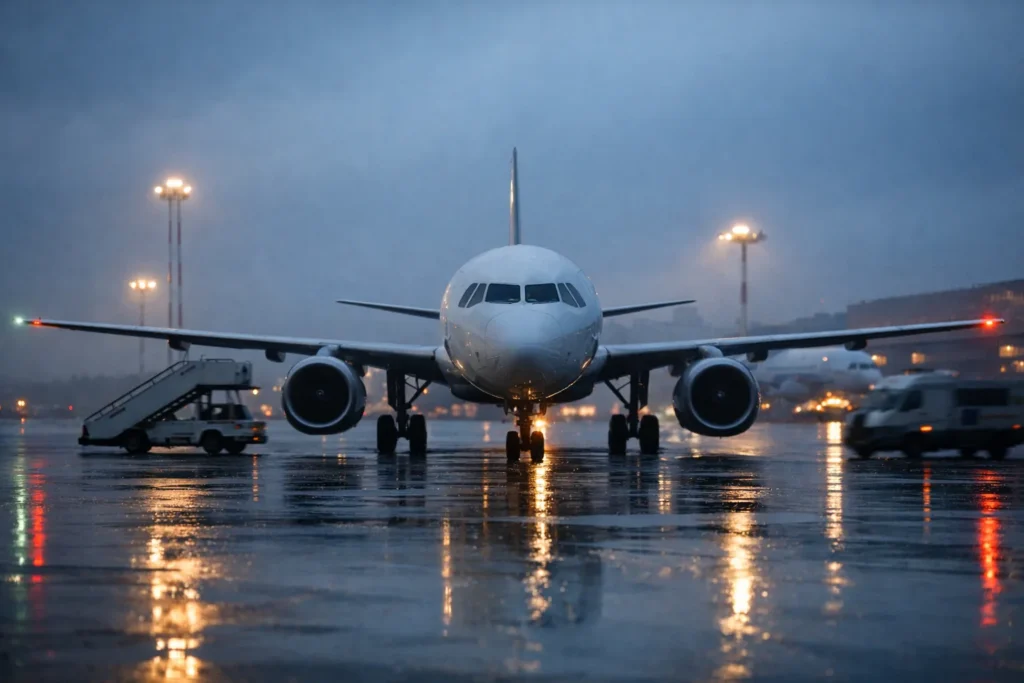
Russia flight safety is under renewed scrutiny as Air Tanzania prepares to restart its Dar es Salaam-Moscow service on September 7 after a brief suspension. The carrier reversed its decision following another risk review, although drone attacks and Russian air-defence operations continue to disrupt aviation.
The main danger extends beyond a drone collision
The broader risk comes from mixing passenger aircraft with drones, missiles, military radar and electronic warfare in the same area.
Russian air defences activate when Ukrainian drones enter the country. This can expose civilian flights to mistaken identification, missile debris and airport restrictions imposed with little warning. Ukraine says it does not target civilian aviation, while Russia maintains that its security procedures protect commercial operations.
Satellite-navigation interference adds another complication. Modern airliners can operate without GPS, but jamming or false signals increase pilots’ workload when reliable separation between military and civilian traffic is especially important.
The December 2024 Azerbaijan Airlines crash remains central to assessments of this risk. The aircraft was heading towards Grozny while Russian forces responded to Ukrainian drones, and 38 people died. Russian President Vladimir Putin later acknowledged that Russian missiles had detonated near the aircraft during the air-defence operation.
Regulators remain cautious about Russia flight safety
The European Union Aviation Safety Agency recommends that affected operators avoid a large part of Russian airspace at every altitude.
EASA’s conflict-zone bulletin covers areas west of 60 degrees east, including the flight-information regions around Moscow, St Petersburg, Rostov, Samara and Yekaterinburg. The warning remains valid through January 31, 2027.
The regulator identifies air-defence activation and weaknesses in coordination between civil and military aviation as key hazards. It also notes that previous military responses began without the airspace being closed beforehand, potentially leaving passenger aircraft nearby.
The US Federal Aviation Administration maintains restrictions affecting American civil aviation in parts of Russia. The UK advises against all travel to the country and includes drone attacks, air-defence activity, diversions and cancellations among the concerns.
Airlines are making different operating decisions
Some non-Western carriers continue serving Russia, while others cancel individual flights or pause routes when conditions deteriorate.
Air Tanzania originally suspended flights TC422 and TC423 from September 4 following a risk assessment. It announced the reversal after consulting relevant authorities and reopened bookings. Passengers who received refunds during the suspension can rebook without an additional charge.
The Tanzanian flag carrier launched the route in July 2026, flying from Dar es Salaam via Zanzibar three times a week. Russian visitors are an important market for Tanzania’s tourism industry.
Turkish Airlines, Pegasus Airlines, Emirates, Etihad Airways and flydubai are among the international carriers maintaining Russian links. Airlines from China, Central Asia, the Caucasus, Serbia and Belarus also provide services. Pegasus has temporarily cancelled some flights during recent disruption, while flydubai has warned that services may be delayed or diverted as conditions change.
Major European, British and North American carriers remain absent. Lufthansa, British Airways, Air France, KLM, Finnair, SAS, LOT, Delta Air Lines, United Airlines and American Airlines do not operate normal scheduled passenger services to Moscow. Sanctions, reciprocal airspace bans and regulations introduced after Russia’s 2022 invasion of Ukraine already kept most of them away before the latest drone concerns.
Airport disruption is the more immediate passenger problem
Delays, cancellations, holding patterns and diversions are more likely to affect an individual journey than a catastrophic incident.
Russian authorities have repeatedly restricted Moscow airports temporarily when drones approach. Operational figures from September 2 show the scale of disruption at two major gateways:
| Airport | Delayed flights | Cancelled flights |
|---|---|---|
| Sheremetyevo | 235 | 21 |
| Vnukovo | 94 | 22 |
Russian officials argue that these closures demonstrate precautions are working by keeping civilian aircraft away from an active interception area. EASA’s position is that the remaining risk is still too high for operators covered by its guidance.
What travellers should do before flying
Passengers should expect schedules to change quickly and check their flight status directly with the airline before travelling to the airport.
Customers booked with Air Tanzania should watch the planned September 7 restart. Those connecting onwards should leave extra time between arrangements, because a temporary closure can affect arrivals and departures even when the airline intends to operate.
Travellers should also review government travel advice and check whether their insurance covers disruption linked to conflict or airspace restrictions. EASA’s current bulletin runs until January 31, 2027, but airlines may revise their schedules sooner if drone activity or airport restrictions intensify.