
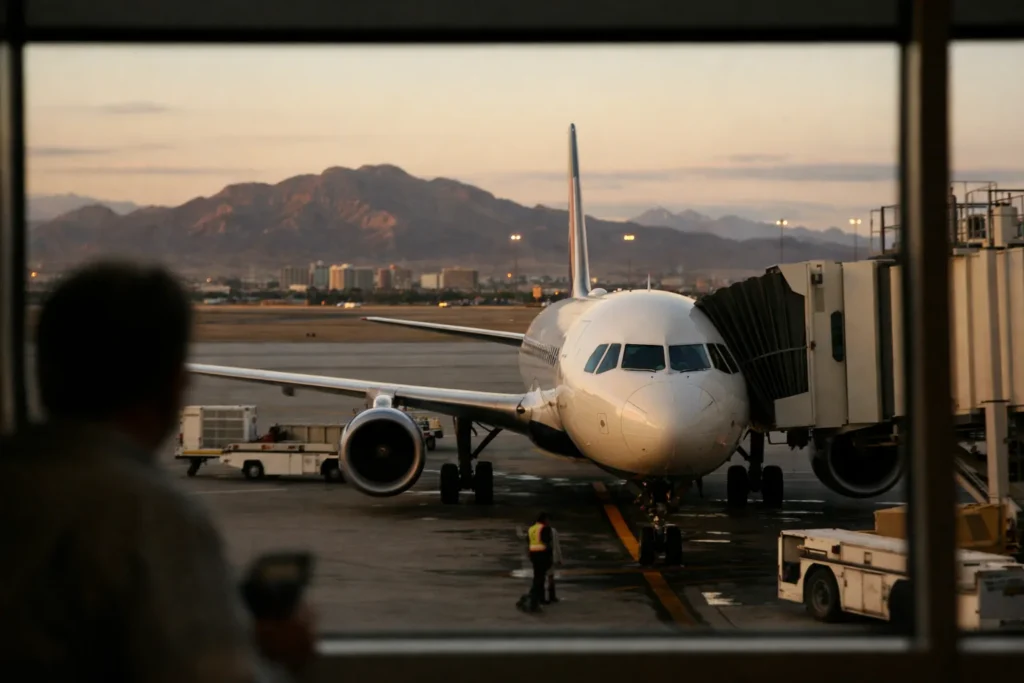
A Delta emergency descent ended in Las Vegas on Sunday evening after a Boeing 737 flying from Los Angeles to Salt Lake City developed a pressurization problem at 35,000 feet. Oxygen masks deployed for the 181 passengers and crew aboard flight DL-2311.
The aircraft had been crossing the Mojave Desert when the problem occurred. The pilots declared an emergency with air traffic control in Las Vegas and requested a rapid descent.
Delta emergency descent took the aircraft toward 9,000 feet
The pilots asked to descend quickly to 9,000 feet, where the lower altitude would reduce the need for supplemental oxygen.
Both pilots put on airtight, full-face oxygen masks equipped with microphones before contacting controllers. During their radio exchanges, they confirmed that masks had also dropped throughout the passenger cabin.
A rapid descent brings an aircraft down much faster than a normal approach. When cabin pressure cannot be maintained at cruising altitude, pilots aim to reach air dense enough for passengers and crew to breathe without relying on the overhead oxygen system.
Although the manoeuvre can feel alarming, it is the expected response to a loss of cabin pressure. Flight attendants are trained to put on a mask immediately, sit down and secure themselves because a steep descent may begin within moments.
Passengers have seconds to respond when masks deploy
The Federal Aviation Administration says occupants at altitude may have only 30 to 60 seconds to put on an oxygen mask before hypoxia begins to impair them.
Hypoxia occurs when the body does not receive enough oxygen. Early effects can include euphoria and poor coordination, which may leave a person unable to fit a mask without help. Loss of consciousness can follow.
Aircraft cabins are pressurized so travellers can breathe normally while the jet flies through thin air. The Boeing 737’s passenger masks are designed to deploy when the cabin altitude, a measure based on air pressure inside the aircraft, exceeds 14,000 feet.
That threshold explains why masks can appear even though passengers cannot see an obvious problem. Travellers should place a mask over their nose and mouth immediately and follow the cabin crew’s instructions rather than waiting for an explanation.
The Boeing 737 was 14 years old
The aircraft involved was a 14-year-old twin-engine Boeing 737 registered as N934DZ.
- Flight: DL-2311
- Engines: Two CFM International CFM56 units
- Departure: Los Angeles
- Planned destination: Salt Lake City
- Diversion airport: Las Vegas
Delta described the event as an unexpected pressurization issue. The airline did not provide a cause for the malfunction.
Delta says the pilots followed their training
Delta said the flight crew used established procedures to bring the aircraft safely to a more suitable altitude.
The airline apologized to customers for the experience and thanked the pilots, cabin crew and ground support teams for their response. The available details do not include the passengers’ onward travel arrangements after the diversion.
What the incident means for travellers
Passengers affected by a diversion should follow airline instructions for replacement travel and monitor their booking for updated flight details.
For anyone who encounters deployed oxygen masks on a future flight, the immediate priority is to put on a mask before assisting another person. A rapid descent and an unplanned landing may follow, so passengers should remain seated and secured when directed by the crew.