
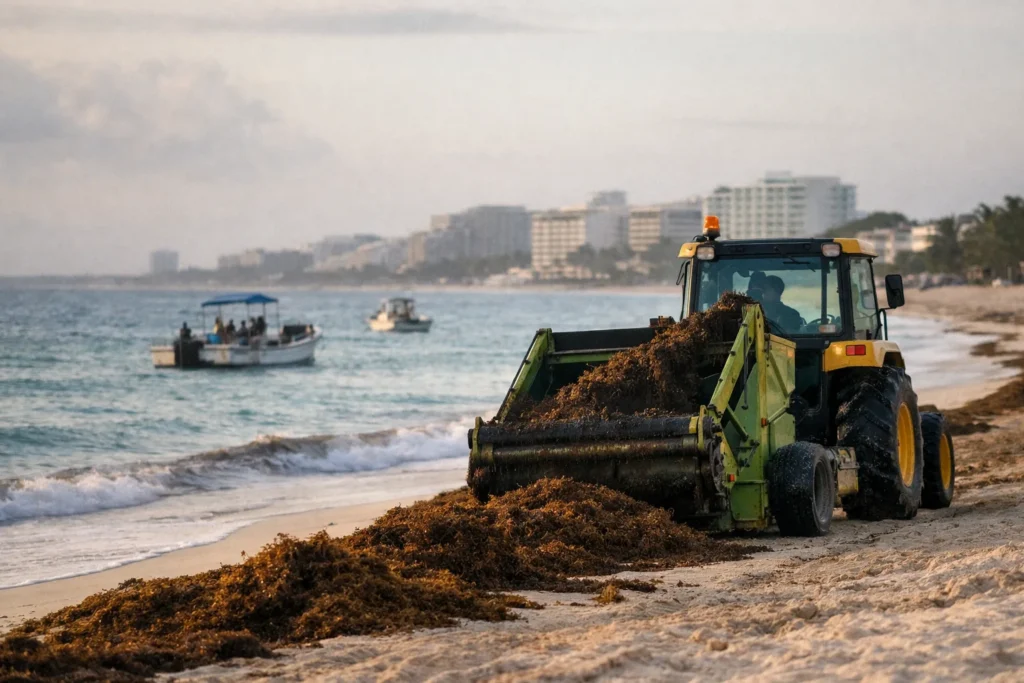
Mexico sargassum cleanup now costs Caribbean coast hotels $20 million to $30 million a year as beach landings intensify in 2026. The Mexican Caribbean Hotel Council says operators are paying to clear shorelines and protect sand in Quintana Roo resorts including Cancún and Playa del Carmen.
Mexico sargassum collection passes the 2025 total by July
Mexico had collected 96,151 metric tonnes by July 30, exceeding the 92,782 tonnes removed during all of 2025, government figures show.
Separate figures from Quintana Roo’s Ecology and Environment Ministry put the state’s 2026 collection at nearly 128,000 tonnes. The two municipalities with the largest reported totals are:
| Municipality | Sargassum collected in 2026 |
|---|---|
| Playa del Carmen | 42,942 metric tonnes |
| Benito Juárez, which includes Cancún | 30,454 metric tonnes |
The National Autonomous University of Mexico estimates that removing and managing large accumulations can cost between $1 million and $1.5 million per kilometre of coastline each year.
Why the seaweed affects beaches and visitors
Large accumulations can produce odours, reduce water clarity and damage the appearance and condition of beaches.
Sargassum is a floating macroalga that provides food and shelter for marine life in open water. Problems begin when large volumes reach shallow water and decompose. This process reduces dissolved oxygen and releases hydrogen sulfide, with potential effects on seagrass and coral reefs.
Large blooms have appeared in the tropical Atlantic since 2011, forming a belt that stretches from West Africa to the Caribbean and Gulf of Mexico. Currents, winds, water temperature and nutrients all contribute, with no single cause explaining the phenomenon.
José Manuel Lastra, president of Spanish travel agency association CEAV, says the conditions affect the visitor experience but have not prompted cancellations among Spanish travellers. He says many visitors also choose the region for full-service resorts, Maya heritage sites and nature excursions rather than beaches alone.
Hotels intercept algae before it reaches shore
Hotels are combining offshore barriers and collection vessels with beach machinery, staff and screening systems that recover trapped sand.
Palace Company operates a hybrid system with containment barriers and four vessels in the Mexican Caribbean. One of them, the Nova Harvest, is a catamaran fitted with a collection belt and adjustable arms that respond to the volume of algae in the water.
The company has operated a processing plant since 2015. Its screening equipment separates seaweed from rubbish and sand, allowing recovered sand to be returned to affected beaches.
Since the plant opened, Palace Company has processed more than one million cubic metres of the material and restored nearly 100,000 cubic metres of sand to its beaches. Researchers and businesses are also examining potential uses in biofertilizers, biofuels, biogas, biomaterials and construction products.
Government plan adds boats, barriers and equipment
Mexico’s government has announced more than 2 billion pesos, or about $115 million, for a national management strategy.
The programme covers additional collection vessels, containment barriers and equipment for Cancún, Playa del Carmen, Puerto Morelos, Tulum and Mahahual. It also includes plans to process the collected plant material for productive uses rather than treating all of it as waste.
The investment targets collection capacity of 1,870 tonnes a day in 2026 and 4,000 tonnes in 2027. President Claudia Sheinbaum has also asked officials to compile the hotel sector’s most effective containment and management practices.
The hotel association representing Cancún, Puerto Morelos and Isla Mujeres has prepared a technical document outlining procedures already used by its members. These measures will help shape the wider government response.
What travellers should watch before booking
The next date to watch is October 1–2, when Cancún will host an international meeting on sustainable uses for the collected algae. Participants will include Caribbean and Latin American governments, European institutions, financial organisations, businesses, researchers and civil society groups.
Travellers planning a beach-focused stay should ask their hotel what barriers, vessels or daily cleaning systems it operates and check current shoreline conditions before booking. Visitors can also balance beach time with cultural sites, nature excursions and resort facilities, reducing the impact if seaweed affects the coast during their stay.