
Travelling by ferry with a dog seems straightforward enough: buy a ticket, choose one of the pet accommodation options offered by the ferry company and follow the rules on board. That was exactly what I expected when travelling with Fred. Olsen Express from La Gomera to Tenerife.
My journey was from the Port of San Sebastián de La Gomera to the Port of Los Cristianos in Tenerife. I was travelling with my dog and had booked and paid for Pet Room, Fred. Olsen’s outdoor accommodation option for pets.
However, my personal experience was not quite what I had expected before boarding.
Important: this article describes my specific experience as a passenger, what I personally observed and the questions I had after the crossing. I am not alleging that Fred. Olsen Express or any member of its staff broke the law or acted improperly. Where I refer to ferry company policies, I rely on information officially published and available when this article was prepared. Policies may change over time.
La Gomera to Tenerife Ferry with a Dog: My Route
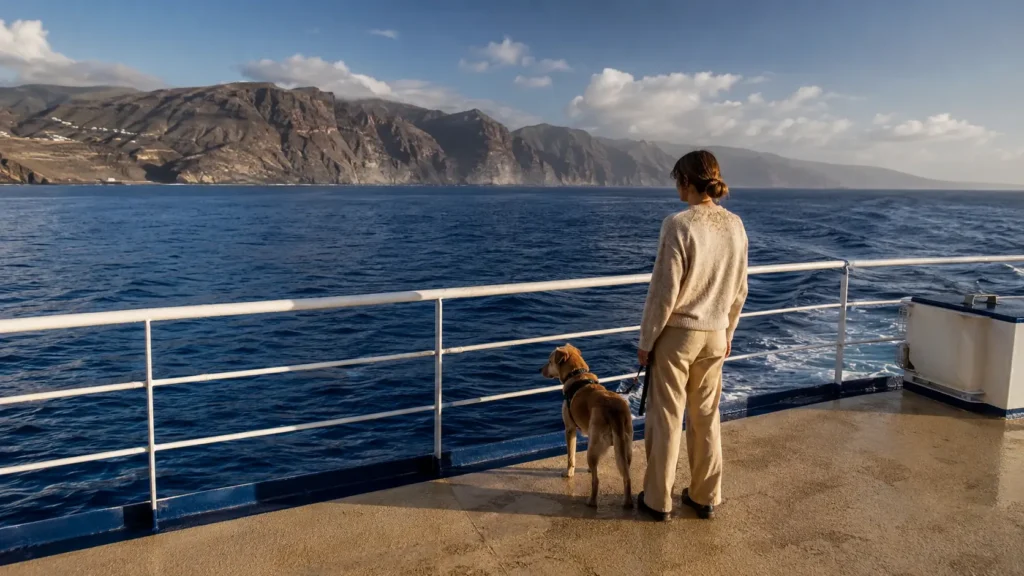
My journey began at the Port of San Sebastián de La Gomera. From there, I travelled with Fred. Olsen Express to Tenerife, arriving at the Port of Los Cristianos.
For anyone taking a ferry from La Gomera to Tenerife with a dog, the timetable and ticket price are not the only things that matter.
It is equally important to understand where the animal will stay during the crossing, whether the owner will be able to remain close to the dog and what practical restrictions apply to the accommodation selected.
That became the most important issue for me during this journey.
What Pet Options Does Fred. Olsen Express Offer?
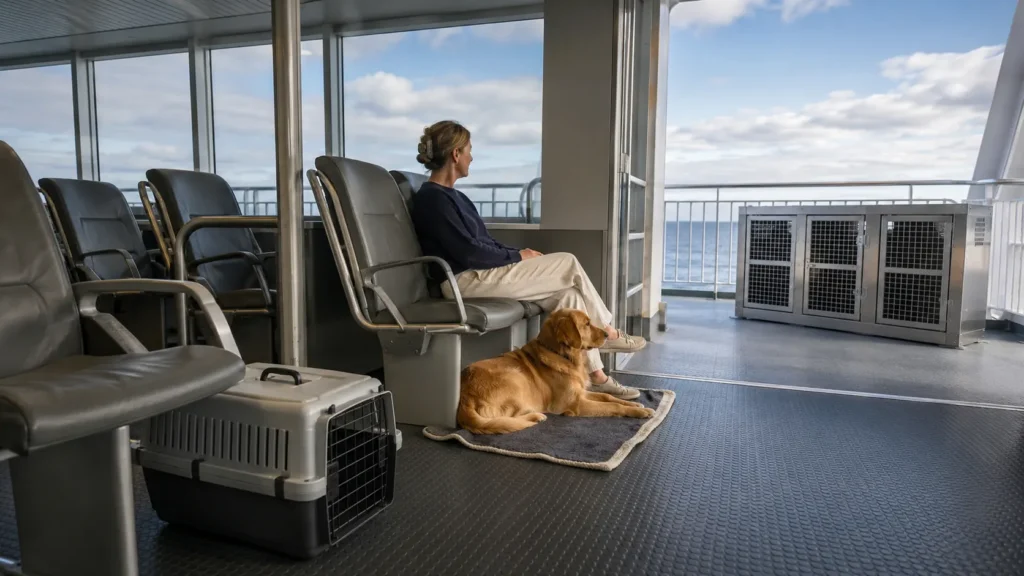
On inter-island services, Fred. Olsen Express offers several pet accommodation options, including Pet Carrier, Pet Room and Pet Sofa.
Pet Carrier is intended for smaller pets. The animal travels in the passenger’s own carrier, which must remain closed and positioned at floor level during the journey.
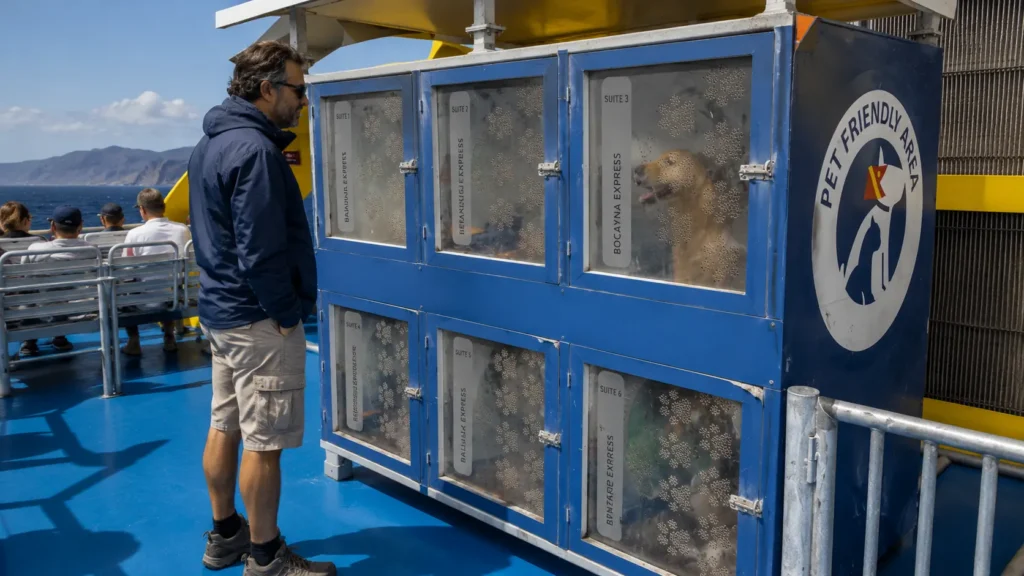
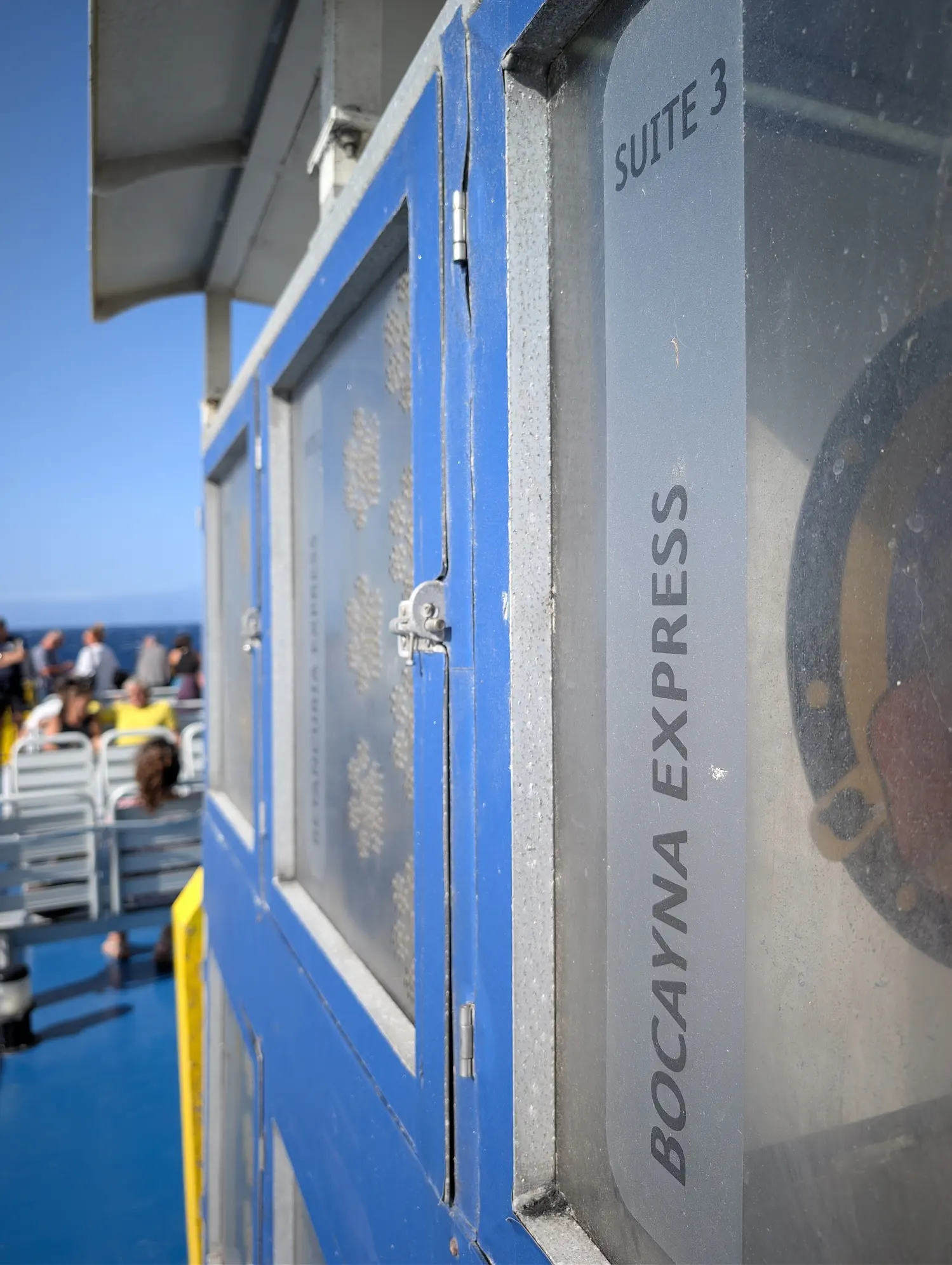
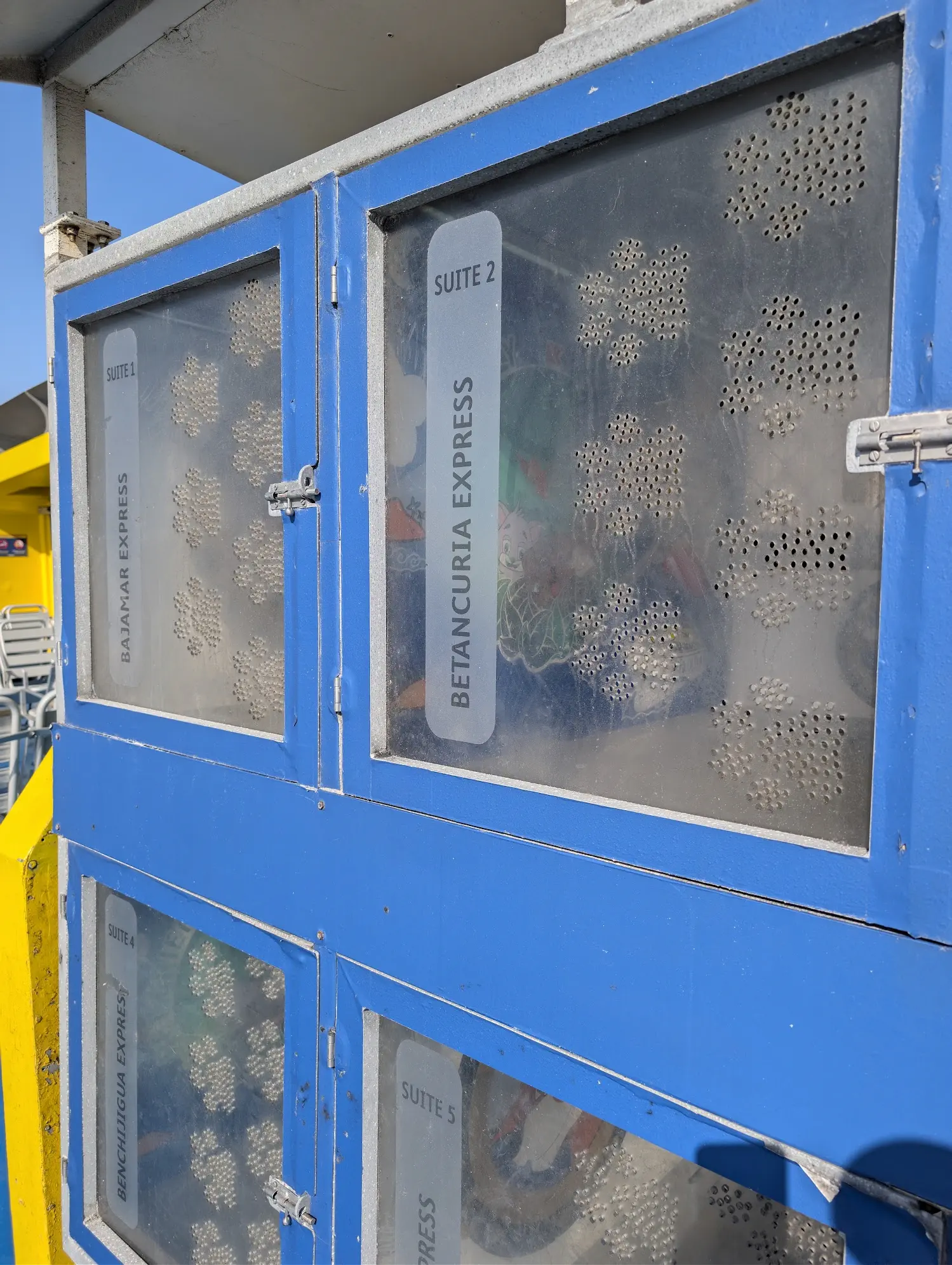
Pet Room is a fixed kennel located on an outdoor terrace of the vessel. Fred. Olsen describes Pet Rooms as shaded and ventilated and states that on most vessels they are accessible during the crossing. Camera monitoring is also provided.
At the time of writing, Fred. Olsen lists Pet Room from €3, although the actual price may depend on the route and booking method. On my particular La Gomera to Tenerife crossing, I paid €4.
Pet Sofa is a different arrangement. The dog can travel inside the vessel without a carrier, on a mat beside the passenger’s seat in a designated pet-friendly area, using the restraint system provided by the company.
Fred. Olsen currently lists Pet Sofa from €7.
Official Fred. Olsen Express information about travelling with pets
An Important Transport Condition: Pet Rooms Must Remain Closed
After my journey, I also reviewed Fred. Olsen’s general Conditions of Carriage.
Those conditions contain an important provision that needs to be considered together with the public description of Pet Room: Fred. Olsen states that carriers, cages/terrariums and Pet Rooms must remain securely and permanently closed during transport.
Animals travelling in Pet Sofa are separately required to remain on a lead.
Official Fred. Olsen Express Conditions of Carriage
This is important because it provides relevant context for what happened during my crossing.
I therefore do not claim that a Pet Room booking entitled me to take my dog out of the kennel and remain with the animal on an ordinary passenger deck.
Nor do I claim that the crew member who asked me to place my dog in Pet Room acted contrary to Fred. Olsen’s published conditions.
My remaining concern is different: how clearly is this practical consequence of choosing Pet Room explained to a passenger before the service is purchased?
What Happened During My Crossing
During the crossing from San Sebastián de La Gomera to Los Cristianos, my dog spent some time with me on an outdoor passenger terrace.
The dog was calm, did not bark and, as far as I could observe, was not causing inconvenience to other passengers. The animal remained under my direct supervision.
At one point, a member of the crew approached me and told me that my dog had to be placed in the Pet Room I had booked.
I followed the instruction.
At the time, I did not know which specific published condition or internal instruction was being applied. Having subsequently reviewed Fred. Olsen’s Conditions of Carriage, I am now aware of the provision requiring Pet Rooms to remain securely and permanently closed during transport.
I am therefore not presenting this incident as evidence that the crew acted incorrectly.
What I am questioning is how clearly the practical restriction attached to Pet Room is communicated during the booking process.
What Does Fred. Olsen Say About Leads?
Fred. Olsen’s passenger information also states that an animal travelling in Pet Sofa or Pet Room does not necessarily have to board in a carrier: it may board walking beside its owner on a lead, subject to crew instructions.
The company additionally states that when a pet is outside a carrier, it must be kept on a lead from the pre-boarding area onwards.
However, I do not interpret those provisions as permission to remove a dog from Pet Room during the crossing or to take the dog into any passenger area of the vessel.
The separate Conditions of Carriage concerning Pet Room must also be taken into account.
The fact that a dog may board on a lead and the fact that Pet Room must remain closed during transport relate to different stages and conditions of the journey.
For me, the important consumer question is whether this distinction is sufficiently clear before booking.
My Main Question About Pet Room
After reading both Fred. Olsen’s pet information page and its Conditions of Carriage, I would formulate my question as follows:
when a passenger books Pet Room, how clearly is it explained before payment that, although the dog may board on a lead and the Pet Room area may be accessible to the owner on most vessels, the Pet Room itself is required to remain securely and permanently closed during transport?
This is no longer a question about whether such a condition exists. Fred. Olsen’s Conditions of Carriage contain it.
My question concerns the clarity and prominence of that practical restriction for a customer deciding between Pet Room and Pet Sofa.
For a dog owner, this may materially affect the choice of service.
€4 for My Pet Room and Pet Sofa from €7
I paid €4 for Pet Room on my particular crossing.
At the time this article was prepared, Fred. Olsen’s published price for Pet Sofa started from €7.
There is nothing unusual about different services having different prices and different conditions.
The practical difference, however, is significant.
With Pet Sofa, the company provides for the dog to remain beside the passenger inside a designated pet-friendly area.
With Pet Room, the dog travels in a separate outdoor kennel which, according to Fred. Olsen’s Conditions of Carriage, must remain securely and permanently closed during transport.
For me, this makes the distinction between the two products considerably more important than the difference of a few euros.
A passenger choosing Pet Room should ideally understand this practical difference before paying.
About 20 Minutes Later, the Crew Member Asked Whether I Was All Right
After placing my dog in Pet Room, I chose to remain close to the animal.
Around 20 minutes later, the same crew member approached me again and asked whether everything was all right.
At that point, I was still outside, standing in the wind and sun near the pet accommodation area. During this particular journey, I could also smell an unpleasant odour in that location.
For that reason, in those specific circumstances, the question sounded rather ironic to me.
I do not know and cannot know what the crew member was thinking when asking it, and I do not attribute any motive, hostility or intention to her. It may simply have been an ordinary enquiry about my wellbeing.
What stayed with me was the contrast.
I could see passengers using the indoor areas of the vessel, while I had personally chosen to remain outside near my dog.
That experience was one of the reasons I later examined Fred. Olsen’s pet travel conditions in more detail.
Pet Room Is Accessible on Most Vessels — but the Kennel Must Remain Closed
Fred. Olsen states on its pet information page that Pet Rooms are located on vessel terraces, are shaded and ventilated and, on most vessels, are accessible during the crossing.
Its Conditions of Carriage additionally state that Pet Rooms must remain securely and permanently closed during transport.
I understand these provisions together as meaning that access to the Pet Room area or the possibility of visiting the animal should not automatically be interpreted as permission to remove the dog from the kennel.
That distinction is important.
For me, the issue is therefore not whether the rules can be read together. They can.
The issue is whether the practical consequence is sufficiently obvious to a passenger at the point of booking.
I Do Not Consider Pet Room a Bad Service in Itself
Pet Room may be suitable for many animals and owners.
Some dogs cope perfectly well with separate accommodation, and some owners may prefer to leave their pet in a dedicated kennel while using other parts of the vessel.
Fred. Olsen provides shade, ventilation and camera monitoring for Pet Rooms.
My criticism is therefore not directed at the existence of Pet Room.
It concerns how clearly the practical limitations of the product are explained before purchase.
If the key practical difference is that the dog must remain inside a closed Pet Room during transport rather than simply being allowed to remain beside the owner on a lead, I believe that distinction deserves to be especially clear during booking.
Fred. Olsen Provides a Pet-Friendly Terrace on Another Service
Fred. Olsen also states that the ferry operating between the Canary Islands and Huelva has a pet-friendly terrace area where passengers can walk and spend time with their pets.
This is a different route and a different service.
I am not suggesting that passengers on the La Gomera to Tenerife inter-island route have a right to an equivalent area.
The vessels, layouts and operational requirements may be different.
The existence of such an arrangement does, however, show that Fred. Olsen uses different models for travelling with pets on different services.
That leads to a constructive question:
could a similar outdoor pet-friendly area be offered on some inter-island vessels, or, where that is not possible, could the differences be made particularly clear to passengers before booking?
This is a question about service design and transparency, not an allegation of unlawful conduct.
What to Check Before Travelling by Ferry with a Dog
If you are planning a La Gomera to Tenerife ferry with a dog, I would now recommend checking more than the fare and timetable.
Before booking, it is worth confirming:
- whether the chosen service is Pet Room, Pet Sofa or Pet Carrier;
- where Pet Room is located on the particular vessel;
- whether owners can visit the Pet Room area during the crossing;
- whether the Pet Room must remain closed throughout transport;
- whether there is a designated outdoor pet-friendly area;
- where a dog may legally and contractually remain outside a carrier;
- what practical difference Pet Room and Pet Sofa make for an owner who wants to stay close to the animal.
Conditions can vary by vessel and route, so the information should be checked for the specific sailing.
Pet Policies Differ Between Ferry Operators in the Canary Islands
After my journey, I also looked at other ferry operators.
Comparisons should be made carefully. Different companies use different vessels and their own operational and safety procedures. The fact that one operator offers a particular arrangement does not mean another operator is required to provide the same service.
Nevertheless, different models for ferry travel with pets do exist.
Naviera Armas / Armas Trasmediterránea — Now Baleària Canarias
The Naviera Armas and Armas Trasmediterránea names remain familiar to passengers in the Canary Islands and continue to appear in travel searches.
The company’s official website currently states that Armas Trasmediterránea is now Baleària Canarias.
Official Armas Trasmediterránea website
For current pet travel conditions, Baleària Canarias states that pets may, depending on the route, vessel, animal and availability, travel in different accommodation types. Its help centre also describes designated outdoor areas in which pets may travel with a compulsory lead and subject to hygiene and passenger-respect requirements.
This does not mean that such an outdoor area is available on every La Gomera to Tenerife sailing.
Current Baleària Canarias information about travelling with pets
Baleària with a Dog
Baleària also publishes several pet-friendly travel options and states that, on vessels where sufficient space is available, there may be dog exercise areas and designated pet facilities.
I mention Baleària solely as an example of another model for organising ferry travel with pets, not as evidence that Fred. Olsen Express must apply the same rules.
Official Baleària information about travelling with pets
What Could Be Improved, in My View
Based solely on my own experience, I think the booking process could make one point particularly prominent:
Pet Room is not simply an outdoor place allocated to the dog; according to Fred. Olsen’s Conditions of Carriage, the Pet Room must remain securely and permanently closed during transport.
That condition can make a major practical difference to an owner.
It would therefore be useful if the booking process clearly explained:
- whether the dog must remain inside Pet Room throughout the crossing;
- how visits to the Pet Room work;
- whether any separate outdoor pet-friendly area exists;
- how Pet Room differs from Pet Sofa in terms of remaining physically close to the animal.
A short, clear explanation could prevent passengers from forming expectations that do not match the conditions applied on board.
My Conclusion After Travelling with Fred. Olsen from La Gomera to Tenerife
Fred. Olsen Express offers several ways to travel with pets.
Pet Room is an outdoor kennel; Fred. Olsen states that it is shaded, ventilated and accessible on most vessels during the journey. Its Conditions of Carriage also state that Pet Rooms must remain securely and permanently closed during transport.
Pet Sofa is a different product that allows the dog to remain beside the passenger in a designated indoor pet-friendly area.
My personal Pet Room experience during the crossing from San Sebastián de La Gomera to the Port of Los Cristianos in Tenerife left me with a consumer question rather than a legal accusation.
During the episode described, my dog was calm, under my control and did not bark. A crew member told me that the animal had to be placed in Pet Room, and I followed that instruction.
Having subsequently reviewed the Conditions of Carriage, I do not claim that this instruction contradicted Fred. Olsen’s published rules.
My question is whether the practical significance of choosing Pet Room — particularly the requirement for it to remain closed during transport — is made sufficiently clear to a passenger before payment.
If I take a ferry from La Gomera to Tenerife with a dog again, I will compare not only prices, timetables and arrival times at the Port of Los Cristianos, but also the exact conditions attached to each pet accommodation.
The issue is not simply a difference of a few euros.
The important point is whether passengers understand before buying the ticket exactly what kind of journey they are choosing for themselves and their dog.