
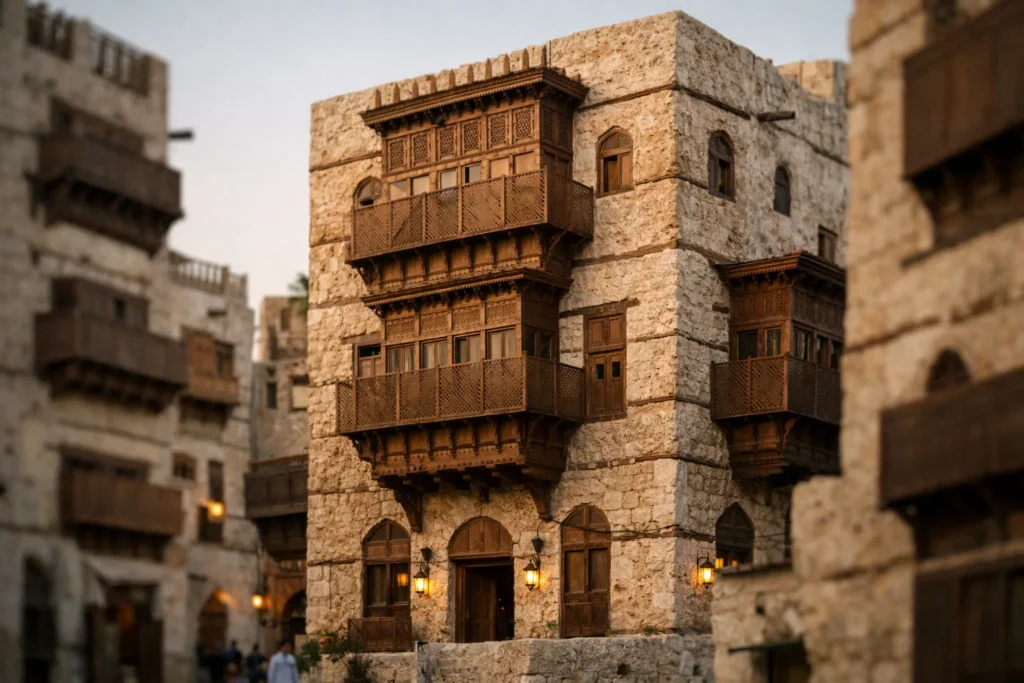
Three Jeddah heritage hotels are now open in Al Balad, giving travellers a place to stay inside Jeddah’s UNESCO-listed old town. The project restores historic merchant houses while adding modern services and supporting work by local artists and craftspeople.
Jeddah developed on the Red Sea as a trading port and gateway to Mecca. Its historic centre preserves the architecture associated with the merchants who helped shape the city.
Restoration keeps coral stone, teak and latticework intact
The three properties retain original architectural details while incorporating electricity and plumbing as discreetly as possible.
The buildings use coral stone and teak, with projecting latticework balconies known as rawsheen. Restored floors, tiles, doors and woodwork preserve the character of the former homes rather than giving them a standard hotel finish.
Furniture, crafts and artworks come mainly from artists and artisans based in the area. Guests can also visit some of their nearby workshops and studios. Each property has a private roof terrace overlooking the streets and buildings of the old town.
Each house offers a different kind of stay
Beit Jokhdar has the broadest room choice, while Beit Al Rayess and Beit Kedwan provide smaller-scale alternatives.
| Property | Accommodation | Notable features |
|---|---|---|
| Beit Jokhdar | Nine rooms and suites | A two-bedroom Royal Suite with a private hammam, uneven historic floors, original tiles and green woodwork |
| Beit Al Rayess | Small heritage property | Cream-and-brown interiors and a ceramic washing bowl recalling how the original household handled ablutions |
| Beit Kedwan | Two bedrooms with living areas | Can be hired in its entirety, making it suitable for a family or two couples |
These are intimate properties rather than large conventional hotels. Their classification makes them the first Heritage Hotels of their kind in Saudi Arabia.
Jeddah heritage hotels put souks and studios within walking distance
The pedestrianised Al Balad district covers about one square kilometre (0.4 square miles), so guests can explore its main sights on foot.
Local souks sell spices, clothing, perfume and gold jewellery. Artisan workshops and artists’ studios also welcome visitors, including spaces in the flower-filled lanes used by the Zawiya 97 arts collective.
Several other historic houses now operate as museums. The Tariq Abdulhakim Centre explores the life and work of the Saudi musician and composer through cultural displays and interactive music installations. Japanese art collective teamLab Borderless opened its immersive Jeddah venue in 2024.
Back at the hotels, guests can have Saudi coffee, tea and figs. Meals are not included in the room rate, although Beit Jokhdar has a restaurant and offers a paid breakfast featuring breads, dips, foul mudamas, halloumi, eggs and fruit.
Another 34 historic houses are due for conversion
The programme is set to restore 34 more Al Balad houses as heritage accommodation over the next three years.
The Saudi Ministry of Culture has also announced plans for part of Al-Falah School to become a museum. Dating from 1905, Jeddah’s oldest school is also expected to contain a cultural space and café.
The expansion will place more overnight accommodation within the protected district while returning additional historic buildings to active use.
What travellers need to know before booking
Travellers should choose between a private whole-house stay and a conventional room or suite, then budget separately for meals.
Rates start at SAR 2,200, approximately £473 or $586. Airport transfers are included, but food is not. Anyone considering Beit Kedwan should check whole-property availability, while larger groups seeking more space can compare it with Beit Jokhdar’s two-bedroom Royal Suite.
For later visits, travellers can watch for opening details for the next restored houses and the planned Al-Falah School museum. Those booking now already have three options within walking distance of Al Balad’s markets, museums, studios and workshops.